


Gold rose to 4,300 USD per ounce on Thursday, marking its fourth consecutive session of gains. The metal has advanced nearly 6% since the start of the week, supported by a partial agreement to reopen shipping through the Strait of Hormuz, which has weighed on oil prices and eased concerns over inflation and further rate hikes.
Iran and Oman agreed to establish a shipping corridor through the strait, raising expectations of a recovery in energy supplies from the Middle East. Against this backdrop, markets have scaled back expectations for Fed tightening, now pricing in only one rate hike before the end of the year, down from two a week ago.
Additional support for gold came from weak ADP employment data. In July, the US private sector added just 44,000 jobs – the lowest since January and well below the 70,000 forecast – adding to signs of a cooling labour market and putting pressure on the dollar.
At the same time, Federal Reserve official Lisa Cook reiterated her readiness to support a rate hike if inflation does not slow, warning that the regulator may not be able to delay action for long to bring inflation back to the 2% target.
Technical Analysis
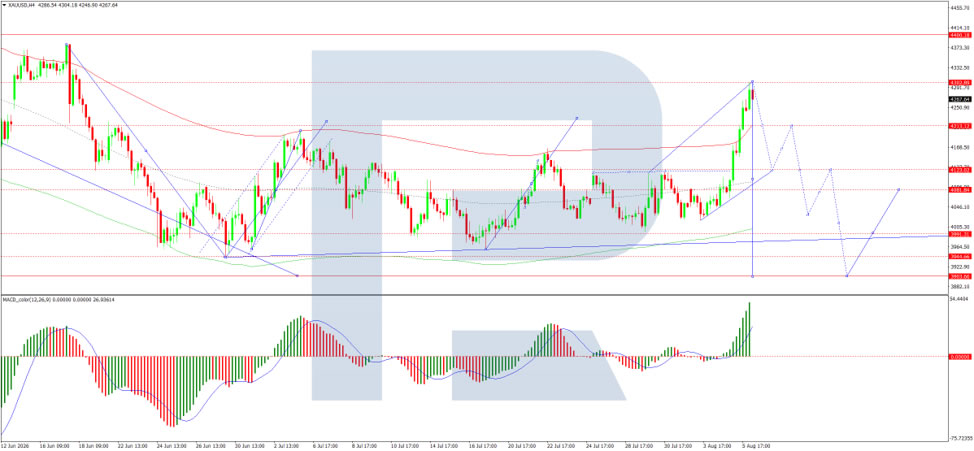
On the H4 XAU/USD chart, the market formed a consolidation range around the 4,102 USD level and, following an upside breakout, moved higher to 4,300 USD. A consolidation range is now forming below this level. A move lower towards 4,100 USD is expected next. The MACD indicator signals the early stages of bearish momentum, with its signal line above the centre line and turning downwards.
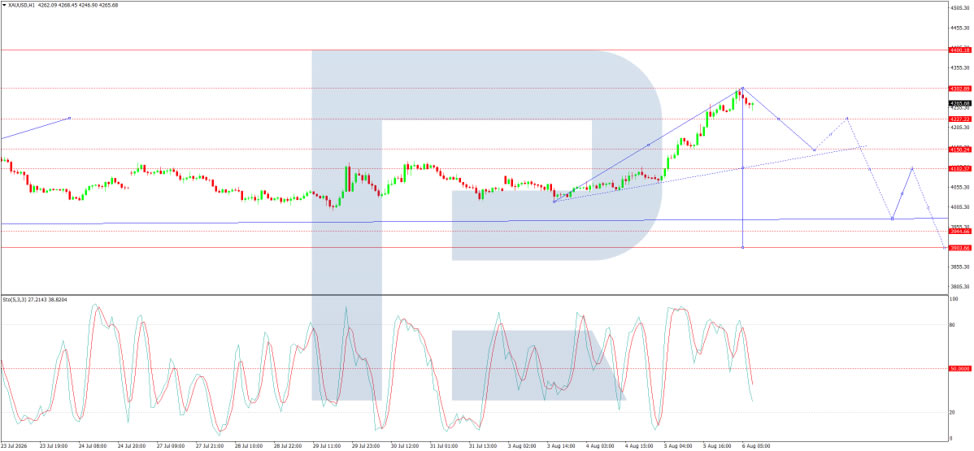
On the H1 chart, the market broke below the 4,272 USD level and moved lower to 4,244 USD, followed by a correction to 4,272 USD. A wide consolidation range is forming around this level. A continuation of the downward move to 4,100 USD is expected. The Stochastic oscillator confirms this scenario, with its signal line below 50 and pointing downwards towards 20, indicating increasing short-term downside pressure.
Conclusion
Gold has rallied for a fourth consecutive day, driven by a partial agreement to reopen the Strait of Hormuz and weaker-than-expected US labour market data. The deal has weighed on oil prices and reduced inflation concerns, prompting markets to scale back expectations for Fed tightening from two rate hikes to just one. Meanwhile, weak ADP employment data added to signs of a cooling US economy, weighing on the dollar. However, Fed official Lisa Cook’s hawkish comments served as a reminder that further tightening remains possible if inflation proves persistent. Technically, gold may see a pullback towards 4,100 USD in the near term, with further direction likely to depend on US economic data and geopolitical developments.





