A major overhaul of the ECB’s six-seat Executive Board looms in 2027, with three seats changing hands between May and December at the latest, including those of the president and chief economist. Speculation about President Lagarde leaving before her term ends in October 2027 has intensified, as she has kept the possibility open. Chief economist Philip Lane leaves in May, followed by market operations head Isabel Schnabel in December. However, Schnabel will leave early on 3 January 2027 for a senior IMF job. In this piece, we assess the candidates, policy implications and appointment process.
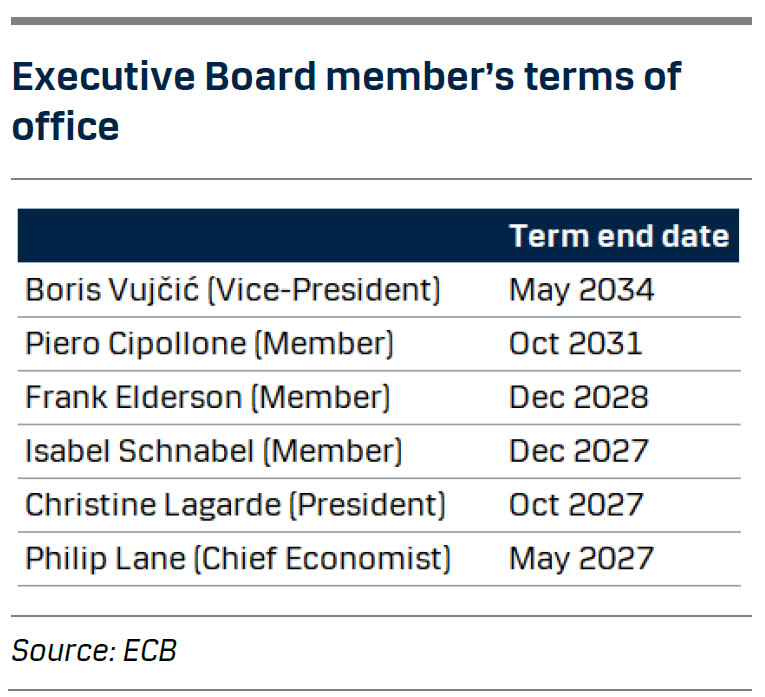
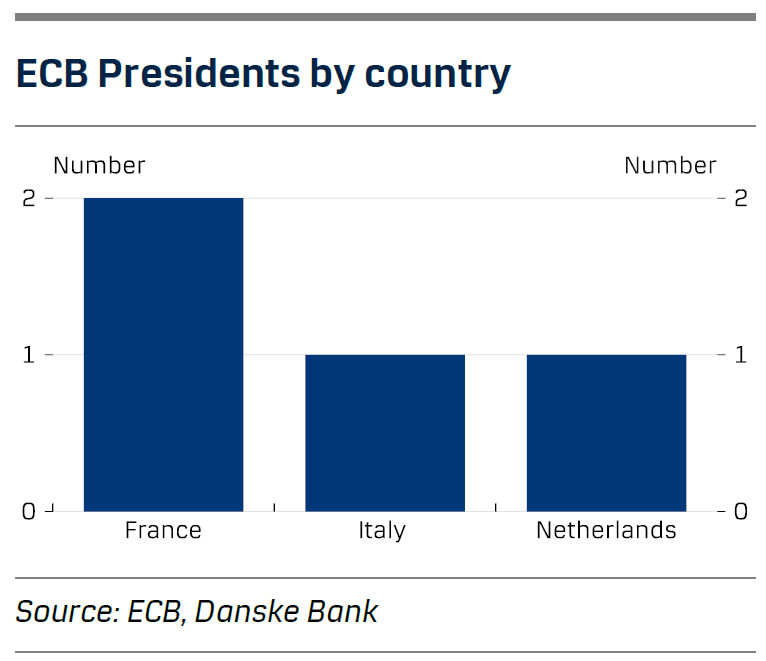
There are few firm rules in the ECB’s game of musical chairs, but the seats are politically important and prestigious for euro area governments. Historically, compromises have balanced northern and southern euro area representation on the board. As the euro area has expanded, the balance between eastern and western countries has also gained importance. However, Croatia’s Boris Vujcic has already become vice-president and is the first Executive Board member from a country that joined the EU after 2004, partly addressing eastern Europe’s claim to a seat in this round. Historically, large euro area countries have dominated the Board, as the charts to the right show.
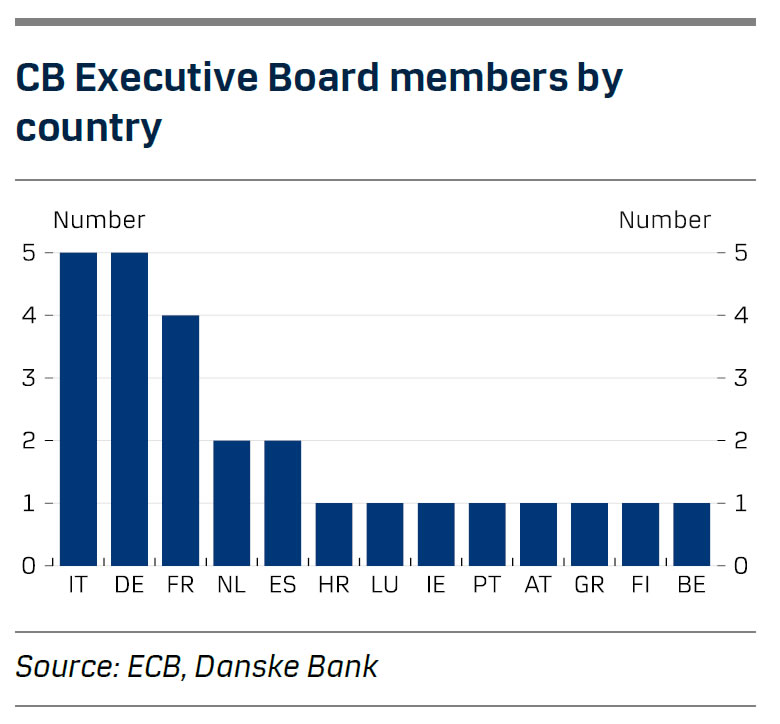
Against this backdrop, attention is turning to the contest for the three seats, particularly the presidency. Although formally separate, the appointments are likely to be closely linked to preserve the political balance. Another French president looks unlikely, as France has already held the presidency twice. Germany’s chances are also slim because it already holds two key EU positions, namely Ursula von der Leyen as President of the Commission and Claudia Buch as head of ECB banking supervision. Germany could still put forward Bundesbank President Nagel for ECB President, but the two most-mentioned candidates are Klaas Knot, former head of the Dutch central bank and FSB chair, and Pablo Hernandez de Cos, now BIS General Manager and formerly governor of the Bank of Spain. Both candidates are officially endorsed by their respective governments.
Klaas Knot is typically seen as a pragmatic hawk, while de Cos is seen as a moderate dove relative to President Lagarde, whom we view as neutral. Knot explicitly criticised the ECB’s September 2019 policy decisions, particularly the open-ended restart of QE. In 2022, he was the first GC member to say publicly that the bank should raise interest rates. However, we see him as pragmatic and data-driven, as he later revised, for example, his initial criticism of Draghi’s “whatever it takes” policy, unlike Bundesbank President Weidmann.
In contrast to Knot, we see de Cos as moderately dovish. At the September 2023 meeting, when the ECB delivered its tenth consecutive hike to 4.0% – which Lagarde called “a close call” – de Cos was on the dovish side and quickly viewed that level as the peak. He was then an early advocate of the 2024 easing cycle compared with the hawks, although less dovish than Cipollone, Panetta and Stournaras. We therefore see him as a “moderate” dove.
As the chances of France or Germany securing the presidency are slim, they will probably focus on the board’s other two seats. According to a Reuters sources story, Macron would reportedly back Knot if France secured the chief economist role in return, although the Executive Board formally assigns the individual portfolios itself. The reported shortlist includes Banque de France Deputy Governor Agnes Benassy-Quere, former OECD chief economist Laurence Boone, and Helene Rey, professor at LSE and head of the BIS Monetary and Economic Department. In terms of German candidates, Bundesbank President Nagel could be put forward for Schnabel’s seat as his odds of becoming President are relatively low. According to an FT sources story, Germany is also considering Princeton economist Markus Brunnermeier, Stanford professor Monika Piazzesi, and former IMF economist Tobias Adrian for the chief economist position.
Implications for Monetary Policy
As the previous section shows, many names are in contention, and more candidates may emerge at the eleventh hour from outside the shortlists, as happened with Lagarde, making the implications uncertain. We stress that the policy implications should be assessed across all three seat changes, not through the presidency alone, as the ECB’s decisions are very consensus-driven. Yet, Schnabel is particularly important because she is both highly hawkish and an intellectual heavyweight in GC debates. Her departure alone should therefore make the GC less hawkish, as she is unlikely to be replaced by someone who is as hawkish and influential – even if Nagel gets her seat. Lane, by contrast, is marginally dovish in our view. With de Cos as president, we would thus expect a slightly more dovish board. If Lagarde is replaced by the more hawkish Klaas Knot, Schnabel’s departure could in theory leave the weighted policy stance across the three seats broadly unchanged.
The Appointment Process
The appointment process starts with euro area member states nominating candidates before agreeing on a name in the Eurogroup. The Council then recommends the candidate to the European Council, which consults the European Parliament and the ECB’s GC before making the appointment. The European Council, comprising heads of state, makes the final decision. The Parliament and the ECB’s GC can only delay the process. In its euro area composition, the European Council decides by a reinforced qualified majority, i.e. at least 16 of the 21 euro area countries, representing at least 65% of the euro area population.