


TL;DR: New Zealand’s hung Parliament adds a slow-burning risk for the Kiwi, but NZD/USD has barely reacted, and its downtrend is still being driven by Dollar strength, global risk sentiment and rate expectations rather than the election. The more consequential technical test is 0.5467, the 2020 low, while any lasting political drag will take weeks of coalition talks to show up.
Does New Zealand’s Hung Parliament Threaten NZD/USD?
New Zealand’s official election results have left the incumbent centre-right coalition one seat short of a parliamentary majority, introducing uncertainty over the formation of the next government. Yet the Kiwi has shown little immediate concern, with NZD/USD edging higher despite the political deadlock. While prolonged coalition negotiations could gradually weigh on the currency through uncertainty over fiscal and economic policies, the immediate exchange-rate outlook remains dominated by the US Dollar, global risk sentiment and monetary policy expectations. The political situation therefore represents a potential additional headwind rather than an established driver of NZD/USD’s existing downtrend.
Election Leaves Centre-Right Coalition One Seat Short of Majority
The official count from New Zealand’s November 7 general election, released Friday, confirmed a hung Parliament with 130 seats, including 10 overhang seats. A governing majority requires 66 seats, but the incumbent National–ACT–NZ First coalition secured only 65.
National won 40 seats, ACT 13 and NZ First 12. Labour secured 36 seats, the Greens 17 and Te Pāti Māori five, giving the three parties a combined 58. The Opportunity Party, with seven seats, has consequently emerged as a potentially decisive participant in government formation.
- National–ACT–NZ First coalition: 65 seats (National 40, ACT 13, NZ First 12), one short of the 66 needed
- Labour, Greens and Te Pāti Māori: 58 seats (36, 17 and 5)
- Opportunity Party: 7 seats
The official count also delivered two important constituency reversals. Labour overturned National’s election-night leads in Wairarapa and Hamilton East, winning by 81 and 173 votes respectively. Although recounts remain possible, the revised results have left the incumbent coalition dependent on additional parliamentary support.
Negotiations could prove difficult. Opportunity leader Qiulae Wong has indicated willingness to speak with National first, but has outlined policy demands covering lobbying, supermarket competition, healthcare and climate commitments. She has also opposed Winston Peters remaining foreign minister, introducing a potential obstacle to an agreement with the existing coalition partners.
A confidence-and-supply arrangement remains another possibility, allowing a government to secure parliamentary support without bringing every supporting party into a formal coalition.
The electoral writ is due to be returned on December 3, while Parliament must meet by January 14. Caretaker arrangements apply during the government-formation process.
The immediate consequence is uncertainty over who will govern and on what policy terms, rather than evidence of an imminent constitutional or economic disruption.
Follow NZD/USD and New Zealand’s coalition talks on the ActionForex Telegram channel.
Kiwi Shows Little Immediate Reaction to Political Deadlock
The currency market’s initial response has been relatively restrained.
By early Friday afternoon in New Zealand, NZD/USD was trading around 0.5491, up 0.39% on the day. The Kiwi was also strengthening modestly against Yen and Sterling, despite the uncertain political outcome.
The gains were small compared with NZD/USD’s decline of more than 7% over the preceding three months.
The timing requires caution. Friday’s gains also coincided with a softer Dollar and improving Asian equity sentiment, both of which are relevant to NZD performance.
Nevertheless, the official result has not been accompanied by an obvious, sustained selloff in the Kiwi, despite introducing a potentially prolonged period of coalition negotiations.
Interest-rate markets have been similarly steady. OIS pricing continued to imply approximately 21bps of RBNZ tightening for the December 9 meeting, broadly unchanged from recent readings.
The limited movement in both the currency and rate expectations suggests that investors have not yet made a substantial monetary-policy reassessment in response to the political outcome.
Coalition Uncertainty Could Become a Slow-Burning NZD Risk
The absence of an immediate market reaction does not mean that political uncertainty will remain irrelevant.
A prolonged government-formation process could gradually create an additional source of pressure on NZD, particularly if negotiations leave businesses and investors uncertain about fiscal priorities, spending commitments or the regulatory environment.
The potential effect is more likely to develop over weeks than through a single sharp exchange-rate adjustment.
Political uncertainty could influence investment decisions and confidence if negotiations become protracted. Differences between prospective coalition partners over economic and fiscal priorities could also make the eventual policy direction harder to assess.
However, the evidence does not yet establish that investors are demanding a measurable political risk premium for holding New Zealand assets.
The most useful indication would be persistent Kiwi underperformance during periods when global conditions would normally favor risk-sensitive currencies.
For example, if NZD begins lagging other major currencies despite a weaker Dollar and recovering equities, that would strengthen the case for a New Zealand-specific drag. Relative movements in New Zealand and US government bond yields could provide additional evidence.
Conversely, a relatively smooth coalition agreement could remove much of the uncertainty before it materially affects financial markets.
For now, political developments remain an emerging risk to monitor rather than an explanation for the Kiwi’s existing weakness.
RBNZ Outlook Remains Largely Unaffected
Monetary policy expectations have not materially changed following the official election result.
At its October 28 meeting, RBNZ held the Official Cash Rate at 2.75% by a narrow 4–3 vote, with three Monetary Policy Committee members favoring an immediate 25bps increase. Policymakers nevertheless agreed that further tightening was likely to be required, conditional on the inflation and economic outlook.
The latest OIS readings continue to reflect expectations for additional increases. Approximately 21bps of tightening was priced for December 9, rising to around 45bps by March and 81bps by October 2027.
- RBNZ tightening priced: about 21bps by December 9, 45bps by March, 81bps by October 2027
There has been no clear election-related step change in these expectations.
The RBNZ’s immediate policy considerations remain centered on persistent inflation, domestic demand and the economic outlook. Coalition negotiations could eventually influence fiscal expectations and business confidence, but such effects have not yet become evident in market pricing.
Dollar and Risk Sentiment Continue to Set NZD/USD Direction
The broader foreign exchange and equity-market backdrop remains more important to the Kiwi’s near-term performance.
NZD/USD has declined approximately 3.15% over the past month, while Dollar Index advanced 1.30%. This reinforces the influence of broader Dollar strength on the currency’s existing downtrend, which was established well before the official election result.
Friday’s recovery occurred as Dollar Index eased and Asian equities rallied strongly. Nikkei was up approximately 2.1%, KOSPI gained 4.3%, and Hang Seng advanced 2.3% during Asian trading.
These developments provided a supportive environment for risk-sensitive currencies, helping explain why NZD/USD could recover even as domestic political uncertainty increased.
The US monetary policy outlook also remains relevant. CME FedWatch pricing indicated a 98.6% probability of a 25bps Fed rate hike at the December 9 meeting. Over the coming year, markets priced approximately 81bps of RBNZ tightening, compared with around 68bps for the Fed.
Yet expectations for relatively greater RBNZ tightening have not been sufficient to support NZD/USD against broader Dollar strength and shifts in global risk appetite.
The next significant tests will be the reopening of normal US trading after Thanksgiving, developments in coalition negotiations and the December 9 policy decisions from RBNZ and Fed.
A sustained improvement in global sentiment alongside continued Kiwi weakness would make domestic political risks more relevant. Conversely, NZD/USD recovering in line with other risk-sensitive currencies would reinforce the view that external forces remain dominant.
ActionForex’s Technical View: NZD/USD, Recovery Corrective Near 0.5467 Historic Support
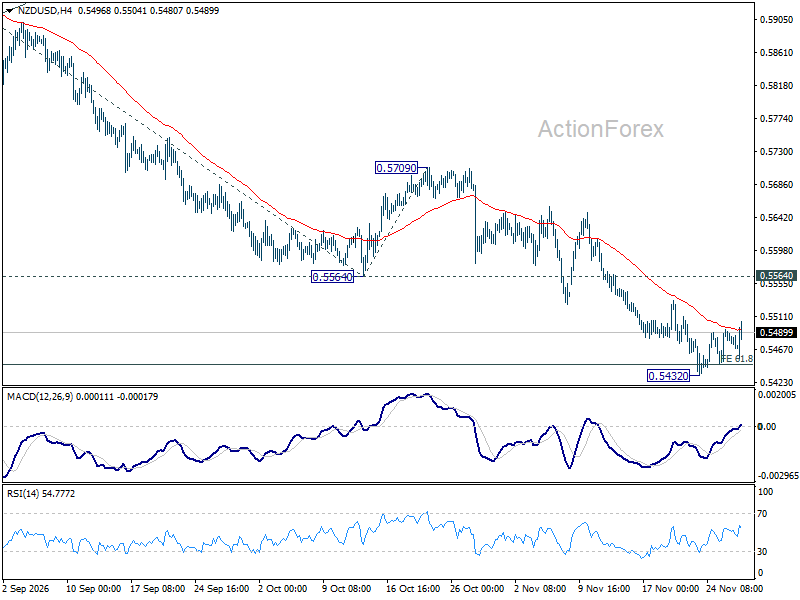
NZD/USD recovered after edging lower to 0.5432 earlier in the week. The structure of the rebound remains corrective so far, suggesting that the larger decline is still in progress.
While further consolidation could be seen, the near-term outlook will remain bearish as long as 0.5564 support-turned-resistance holds.
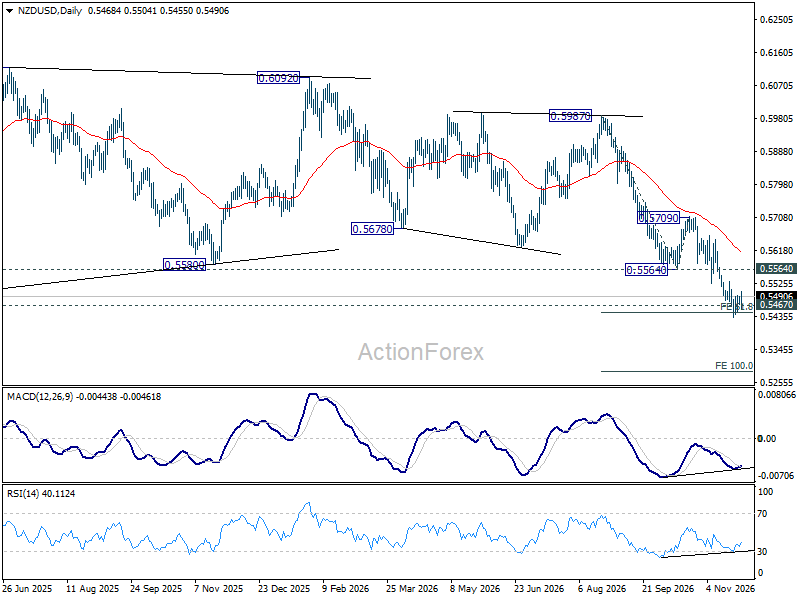
On the daily chart, bullish divergence conditions may be starting to develop in MACD and RSI. However, these are indications of weakening downside momentum rather than confirmation of a bottom, which is not unusual as NZD/USD presses the important 0.5467 support level, the 2020 low, after reaching its lowest level since 2009.
There is still no clear evidence of bottoming, and the outlook remains firmly bearish with NZD/USD trading well below its falling 55-day EMA.
On resumption of the decline, the next target is the 100% projection of 0.5987 to 0.5564 from 0.5709 at 0.5286.
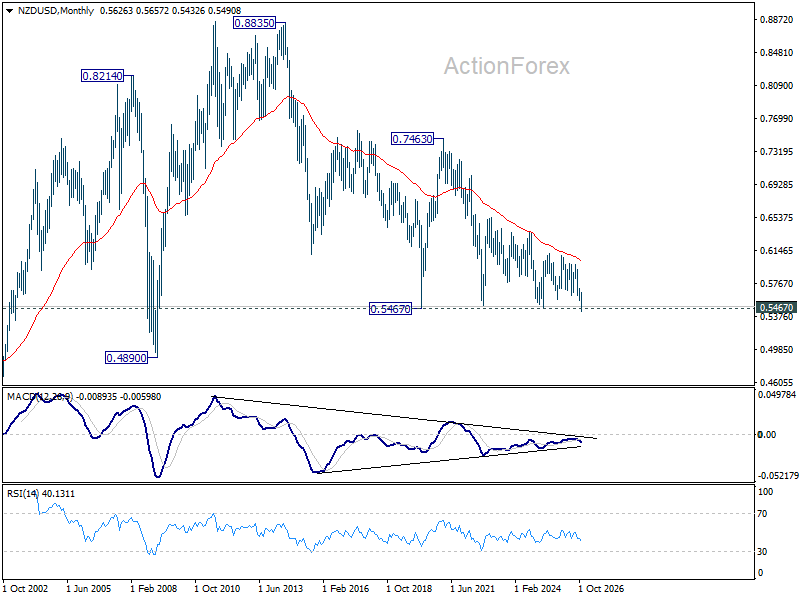
The long-term downtrend from 0.8835 remains in progress, with NZD/USD capped below its falling 55-month EMA.
Decisive break of 0.5467 would strengthen the case for extending the long-term decline toward 0.4890, the 2009 low.
The developing political uncertainty adds another potential risk to an already bearish technical outlook. However, the current downtrend cannot be attributed to the election, and any lasting political influence will need to be assessed against Dollar movements, global risk sentiment and relative interest-rate expectations.
For now, NZD/USD’s recovery from 0.5432 remains corrective, while the test of 0.5467 represents the more consequential longer-term technical development.
Key Takeaways
- The official count left the National–ACT–NZ First coalition on 65 seats, one short of the 66 needed, with the Opportunity Party’s seven seats potentially decisive and the writ due back on December 3.
- NZD/USD edged up 0.39% to around 0.5491 on Friday, and OIS pricing held at about 21bps of RBNZ tightening for December 9, so there is no election-related step change.
- Political risk is a slow-burning headwind, and persistent Kiwi underperformance despite a weaker Dollar and recovering equities would signal a New Zealand-specific drag.
- Dollar strength (NZD/USD −3.15% over the past month, Dollar Index +1.30%) and global risk sentiment, not the election, explain the existing downtrend, even with RBNZ pricing about 81bps against about 68bps for the Fed.
- NZD/USD stays bearish below 0.5564, with 0.5286 as the next target, while a decisive break of 0.5467 would open the way toward 0.4890.
Stay ahead of the RBNZ and Fed decisions on December 9 and NZD/USD’s next move—join the ActionForex Telegram channel for regular market updates and analysis.