


TL;DR: The Dollar Index confirmed a double-bottom reversal after Wednesday’s 25bp hike, with the 2-year Treasury yield and a weaker Dow reinforcing the signal that markets are pricing roughly 100bp of tightening—well beyond the Fed’s own 4.1% median through 2027.
The clearest verdict on the Federal Reserve’s first rate hike since July 2023 came from the Dollar. DXY completed a double-bottom reversal after Wednesday’s decision, decisively clearing its 99.86 neckline and advancing above 100.00. The move was reinforced by a surge in the 2-year Treasury yield and renewed weakness in the Dow, indicating markets interpreted the 25bp increase as the start of a multi-meeting tightening phase rather than an isolated adjustment.
That interpretation is more decisive than the Fed’s own projections. The September Summary of Economic Projections strongly supported further tightening this year, but officials were genuinely divided over what should happen in 2027. Markets chose not to wait for that disagreement to be resolved. Instead, they traded the unanimous decision, the overwhelming support for at least one more 2026 hike, and the upward revisions to inflation as sufficient evidence that policy rates have further to rise.
SEP Delivers a Clear 2026 Signal, but a Divided 2027 Outlook
The FOMC voted 12–0 to raise the federal funds target range by 25bp to 3.75–4.00%. The median projection for the end of 2026 rose from 3.8% to 4.1%, indicating one additional hike after Wednesday’s move.
The distribution was more hawkish than the median alone suggests. Of the 18 officials submitting rate projections, 12 placed the year-end rate at 4.1%, while another four projected 4.4%. Only two expected rates to finish the year around 3.9%. In other words, 16 of 18 officials, or 89%, favored at least one further hike in 2026.
The accompanying economic projections gave the Fed room to remain restrictive. The forecast for 2026 GDP growth was raised from 2.2% to 2.3%, while the unemployment-rate projection was lowered from 4.3% to 4.1%. At the same time, headline PCE inflation was revised from 3.6% to 3.7%, and core PCE inflation from 3.3% to 3.4%. Stronger growth, lower unemployment, and higher inflation collectively weakened the case for treating the hike as a one-off move.
The longer-run federal funds estimate was also nudged from 3.1% to 3.2%. The revision was modest, but it nevertheless indicated officials see the eventual steady-state rate as slightly higher than they did in June.
The complication begins in 2027. While the median rate projection stayed at 4.1%, the distribution was closely divided: eight officials favored another hike, six projected no change, and four expected rates to fall below the 2026 level. The median therefore concealed a committee without a settled view on whether tightening should continue after this year.
Warsh Says the Inflation Standard Hasn’t Been Met
Federal Reserve Chair Kevin Warsh made the reasoning for Wednesday’s decision explicit. Referring back to the standard he set out at Jackson Hole, Warsh said officials needed confidence that underlying inflation was returning to target “clearly and at sufficient speed.” He concluded that this condition hadn’t been satisfied.
Warsh also framed the hike as beneficial to households without significant financial assets or home equity. Restoring price stability, he argued, would allow wage increases to translate into real improvements in take-home pay rather than being eroded by inflation.
Warsh again withheld an individual dot, continuing the practice he established at his first meeting in June. That removed his own preferred rate path from the published distribution, but it did little to dilute the broader 2026 signal coming from the committee.
The Dollar Becomes the Primary Market Signal
DXY’s breakout offers the clearest market expression of that signal. The index formed a double bottom at 98.557 and 98.905, then completed the pattern with a decisive break above 99.863 resistance. That development indicates the decline from 101.80 has likely completed.
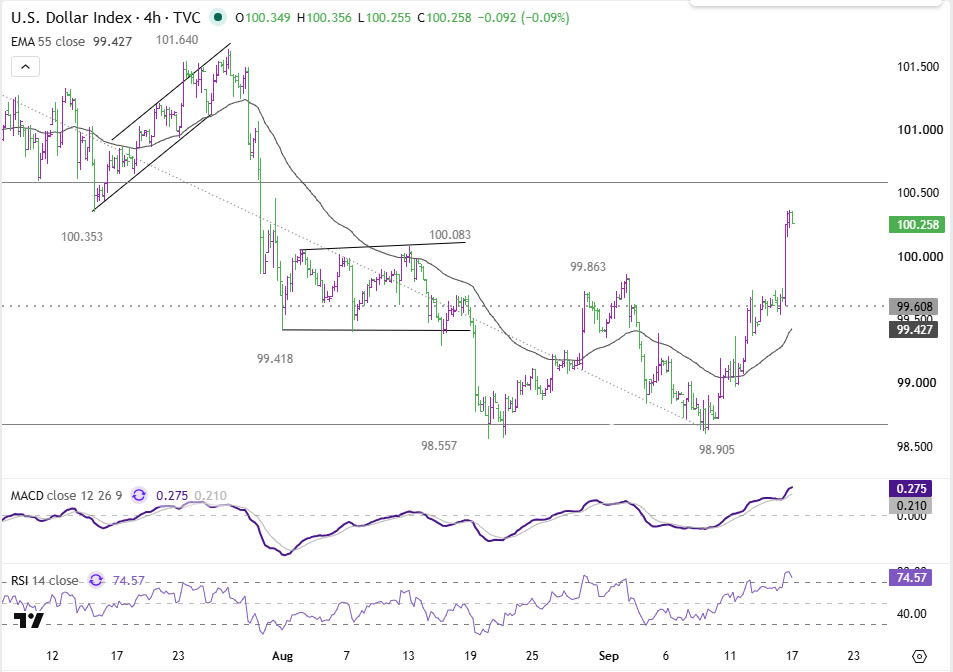
The broader structure is also constructive. DXY rebounded strongly after holding the 98.676 level, representing the 50% retracement of the advance from 95.551 to 101.800. That supports the interpretation that the fall from 101.80 was corrective rather than the beginning of a larger bearish reversal.
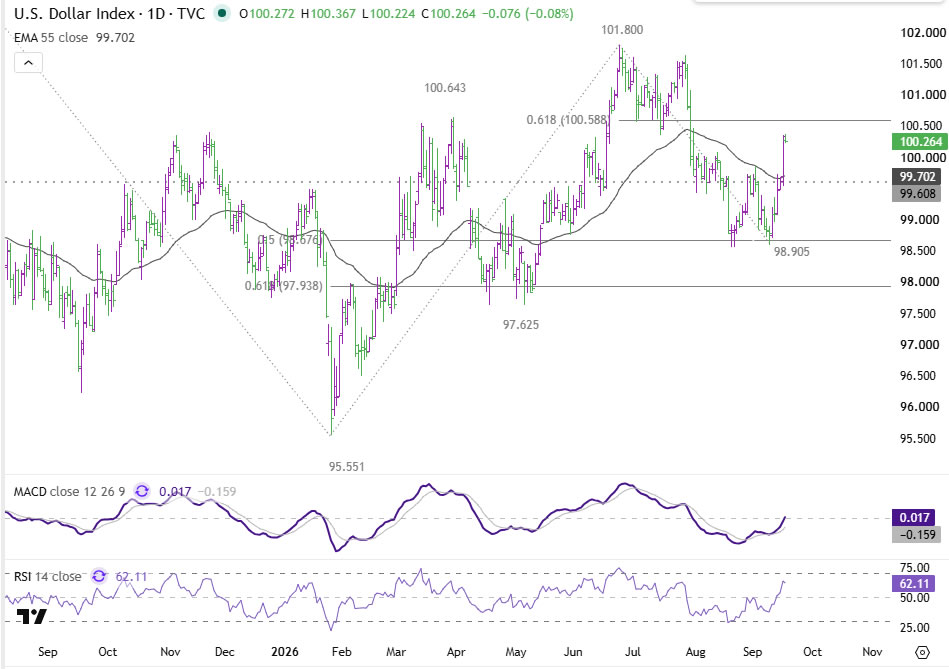
Further gains are favored while 99.608 support holds. The next target is the 61.8% retracement of 101.80 to 98.90 at 100.588, rounded to 100.59. A sustained break there would strengthen the case for a return to the 101.80 high.
Near-term momentum is becoming stretched, with the four-hour RSI above 70. Some consolidation around 100.59 would therefore be unsurprising. However, an overbought pause wouldn’t invalidate the breakout while 99.61 continues to provide support.
Treasury Yields Confirm; Equities Give a Qualified Signal
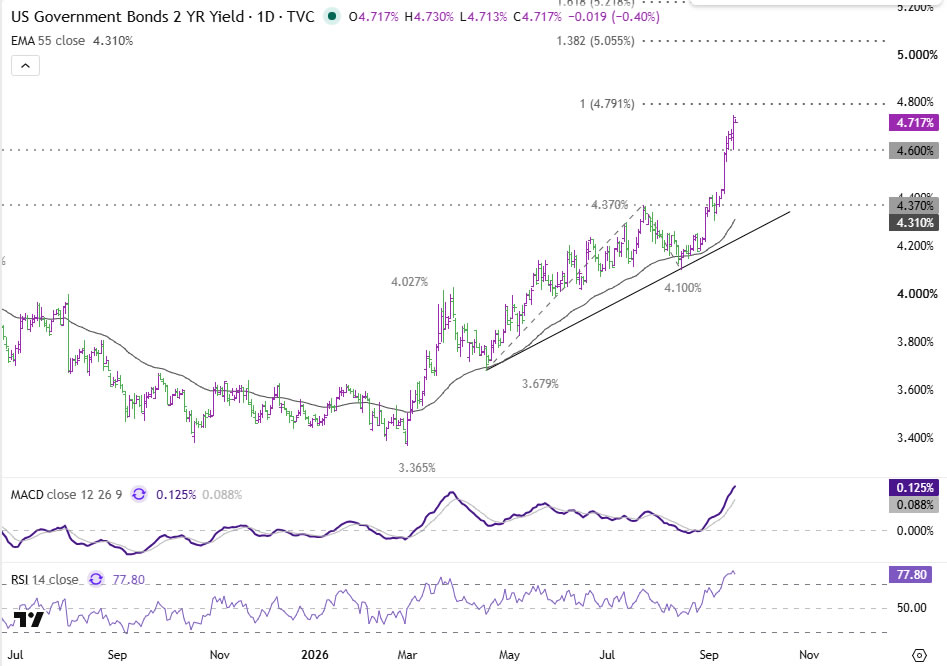
The 2-year Treasury yield provided the most direct cross-market confirmation. It surged to around 4.72%, well above the Fed’s 4.1% median for the end of both 2026 and 2027. The yield doesn’t map mechanically onto the policy rate because it also contains term and risk premiums, but the scale of the move shows traders are unwilling to accept the Fed’s relatively flat median path at face value.
Further gains are expected while the yield holds above 4.600%. The next target lies at the 4.791–4.800% confluence. Daily RSI at 77.80 signals a significantly overbought market, making this area a logical place for the advance to pause. A decisive break above 4.80%, however, would open the 5.055% projection.
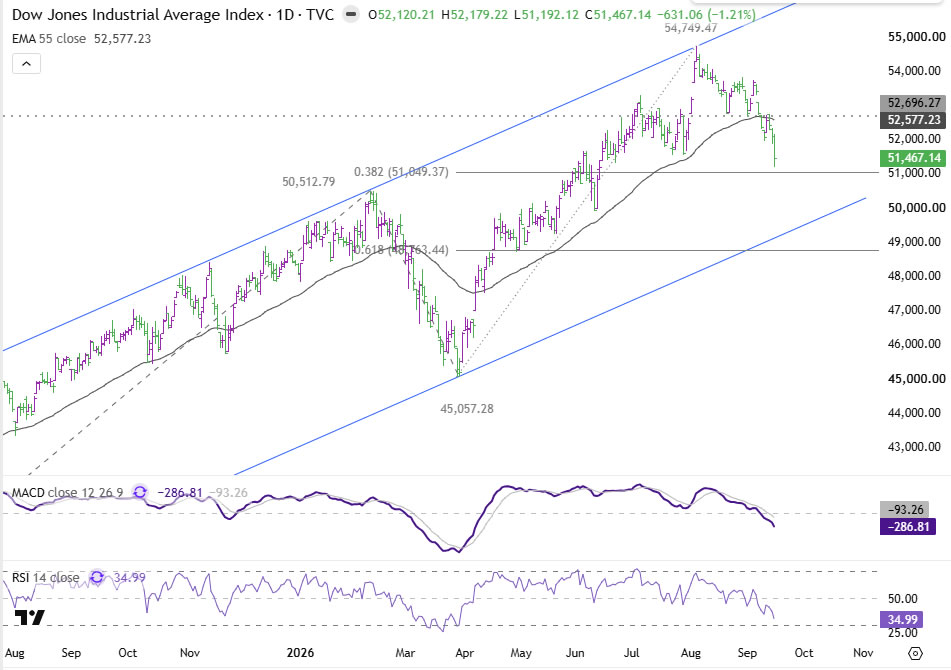
Equities offered a more selective confirmation. The Dow extended its decline from 54,749.47 after failing around its 55-day EMA, while the Nasdaq finished broadly flat. That divergence means the reaction wasn’t a uniform flight from risk. Stronger Fed growth projections may have cushioned technology shares, while the Dow’s more cyclical composition was more exposed to the prospect of tighter policy.
The Dow is now approaching the 51,049.37 retracement support. That level could produce an initial rebound, particularly with daily momentum nearing oversold territory. Nevertheless, near-term risk stays on the downside while 52,696.27 resistance holds. A firm break below 51,049 would expose the medium-term rising channel floor, currently around 49,067.
The Fed–Market Gap Is Now the Trade
The cross-asset message is therefore coherent but not identical in strength. DXY’s confirmed reversal is the primary signal. The 2-year yield provides direct rates-market confirmation, while the Dow’s weakness supplies more qualified evidence because the Nasdaq hasn’t joined the decline.
The unresolved question is how long that alignment can persist. Market pricing has centered on roughly 100bp of cumulative tightening, with the policy rate reaching approximately 4.50–4.55% by mid-2027. The Fed’s median, by contrast, holds at 4.1% through the end of 2027.
Either the market will eventually converge downward toward the Fed’s more cautious path, or incoming data will push policymakers toward the higher trajectory already reflected in yields and the Dollar. The October 28 and December 9 meetings will provide the first tests. Until then, DXY holding above 99.61—and particularly a sustained break through 100.59—would show markets continue to look beyond the Fed’s published median.
Key Takeaways
- The FOMC hiked 25bp to 3.75-4.00% in a unanimous 12-0 vote, with the 2026 median rising to 4.1% and 89% of officials favoring at least one more hike this year.
- The 2027 outlook is genuinely split: 8 officials favor another hike, 6 project no change, and 4 expect rates below the 2026 level, despite a headline median that stayed at 4.1%.
- DXY confirmed a double-bottom reversal by clearing 99.863, with the 2-year yield surging to 4.72%, well above the Fed’s own median, showing markets aren’t taking the flat path at face value.
- Markets price roughly 100bp of cumulative tightening to 4.50-4.55% by mid-2027, a full 30-45bp above the Fed’s own 4.1% median through the same period.
- DXY targets 100.59 while holding above 99.61; the Dow’s weaker, more qualified reaction (Nasdaq finished flat) suggests the market response wasn’t a uniform risk-off move.





